Wednesday, May 22, 2013

Chinese Army's Unit 61398 Hacking Group Back in Action

http://www.nationaldefensemagazine.org/blog/Lists/Posts/Post.aspx?List=7c996cd7-cbb4-4018-baf8-8825eada7aa2&ID=1145&RootFolder=%2Fblog%2FLists%2FPosts

By Yasmin Tadjdeh 

An infamous hacking group affiliated with China's military that was exposed in February has quietly returned after laying low for several months, said an expert with the consulting firm that outed it.

Mandiant released a report
 that pinned numerous cyber-intrusions on Unit 61398 of China's People Liberation Army. The unit, which is based in Shanghai, curtailed its activities after the report's initial release, said Richard Bejtlich, the firm's chief security officer, but it has recently begun to pick up where it left off.

"The group itself went quiet for a while. They changed the nature of their activities [and] they removed some of the tools they had been using inside different companies. But over the course of the last several weeks, it seems like they are starting to come back and ramp up," 
Bejtlich said May 15 at the Center for National Policy, a Washington, D.C.-based think tank.

Unit 61398 has been linked to the theft of huge amounts of intellectual property throughout the world, according to the Mandiant report. It has stolen hundreds of terabytes of data from at least 141 organizations, with the majority of them based in English-speaking countries. It is possible that the unit employs hundreds of operators, the report said.

Besides Unit 61398, Mandiant is monitoring 23 other known hacker groups throughout the world. While he could not say exactly how much data has been stolen, he said it is enormous.

But the threat isn't just in lost data, Bejtlich said. If a group can infiltrate a network to steal data, it can also destroy that network.

"Whenever you hear someone say, 'Don't worry, it's just espionage.' [It's important to realize that] espionage easily can escalate to destruction. It's just the prerogative of the intruder," said Bejtlich.

Another issue Betjlich highlighted was the corruption of data, which he called a "middle ground" between espionage and destruction.


"In some ways it's the toughest one to identify because most companies don't necessarily know what the data should be," he said.

Several cyber security bills were introduced into Congress during the 112th session, but none came to fruition. Earlier this year, President Barack Obama announced an executive order which asked in part for an expansion of the Defense Industrial Base Information Sharing Program, which alerts the Defense Department to attacks on participating companies' software.
While Bejtlich called on Congress to pass legislation, he also said solutions could be found by countries working together. Better communication between nations, and firmer regulations and rules could help alleviate some cyber-attacks. Even a pact between just a handful of countries would be beneficial if it could evolve beyond only talking, Bejtlich said.

"I think government-to-government discussions are necessary, but they will not be sufficient. I think we will ultimately be disappointed if it's simply a discussion," said Bejtlich.

The United States, United Kingdom, Canada, Australia, New Zealand and Israel are the top countries in the world when it comes to cyberdefense, said Bejtlich. Japan and South Korea are also beefing up their defensive capabilities in light of more frequent attacks, he said.

Photo Credit: Thinkstock


Will Nawaz Sharif walk the talk on India

If Pakistan’s new government lives up to the commitments given by Nawaz Sharif [ Images ] that he will not allow Pakistan’s soil to be used against India [ Images ] and will put the jihadist networks out of business, it will create a lot of space for the next government in India to move forward on the bilateral track, says Sushant Sareen
The victory of Mian Nawaz Sharif in Pakistan’s general elections has been viewed with cautious optimism in India. Hope and expectation that perhaps this time things might be different between India and Pakistan are tempered by the realisation that Nawaz Sharif is going to be enmeshed by enormous problems and constraints and he won’t have much space available for taking any bold initiative with India.

At the same time, there is also a sense that Nawaz Sharif’s expressed keenness to normalise relations with India is not so much because he has turned into some kind of an Indophile, but more because he sees in India the answer to many of the problems -- political, economic and strategic -- that pose an existential threat to his country. 

It isn’t as though Nawaz Sharif has suddenly realised the importance of India. Nor is it the case that his charm offensive towards India is only for the sake of form. The fact is that even during his last stint as prime Minister 1997-99, he had tried to break the logjam and more than the Composite Dialogue process or the Lahore [ Images ] bus diplomacy, it was in the back-channel talks between trusted confidants of Nawaz Sharif and Atal Bihari Vajpayee [ Images ] that a serious political effort was made to solve the outstanding problems between the two countries. 

That the whole initiative collapsed, first because of Kargil [ Images ] and then because of the Musharraf coup is well known.

Following the coup in 1999, Nawaz Sharif is believed to have been disappointed by India’s fascination with Musharraf and the fact that until he returned to political relevance in 2008, India seemed to have forgotten about him and considered him irrelevant. Even though some people in India kept advising the powers that be to keep a line open to Nawaz Sharif during his years in wilderness, the general attitude of the policymakers in New Delhi [ Images ] was that Nawaz Sharif is history and that it was a waste of time to cultivate him.

How little the Indian establishment knows about Pakistan can be gauged from just two things: first, even when a child on the streets of Lahore and Islamabad [ Images ] could have told you that Musharraf was damaged goods after his tiff with the judiciary, the then Indian national security advisor was brave enough to say in a TV interview that Musharraf had passed the hump and was now secure; second, the hype in India over Musharraf’s return from exile earlier this year was a display of sheer ignorance because it was as clear as daylight that Musharraf was indeed history.

Fortunately for India, Nawaz Sharif is the sort of person who once convinced about something doesn’t easily change his mind. And it appears that he is convinced about normalising relations with India. Whether he succeeds in this endeavour or falls in the process is altogether another matter. 

While Nawaz Sharif’s recent overtures to India -- assuring that he would not allow another Kargil or 26/11 attack, talking about an holding an enquiry into both these incidents and sharing details with India, saying that he would like to visit India even if he didn’t receive a formal invitation, hinting at inviting the Indian PM to attend his swearing-in -- have received a lot of attention, more so because many of these things he said on the eve of an election that was seen as being too close to call and these statements could have damaged his party’s prospects at the hustings. But then Nawaz 

Sharif has been making the right noises on India for quite some time now.

  • From suggesting that Pakistan should start withdrawing troops from Siachen without waiting for India to do the same, 
  • to talking about the common cultural heritage and likes and dislikes of the two peoples (something that most Pakistani politicians will never say publicly), 
  •  Nawaz Sharif has said things that other Pakistani politicians wouldn’t be caught dead saying. What is more, despite the chagrin this has caused in his core right-wing, conservative constituency, and the glee his apparent boo-boos evoked among many of his detractors, he hasn’t been deterred by criticism nor has he backtracked on anything he has said.
It would be a mistake to dismiss his statements as a sign of his impetuousness or worse, simple politeness without meaning anything he said. Nothing matures a politician more than spending a stint in prison as a political prisoner. Add to this a spell of exile, and generally what you get is a leader who has had the luxury of being able to think things more deeply and reach a level of understanding which is not possible in the normal rough and tumble of everyday politics.

Of course, there are exceptions, and Nawaz Sharif’s bĂȘte noire Gen Pervez Musharraf [ Images ] is one person who doesn’t seem to have learnt anything from his years in exile. Nawaz Sharif on the other hand has emerged as a statesman (something he demonstrated by resisting the temptation to pull down the previous government by hook or by crook), and not only has he mellowed and matured as a politician, he is also no longer the impulsive man with a short attention span that he was during his last tenure as prime minister. 

This means that while he will be very clear headed about what he wants to achieve, he is expected to go about his task in a very calibrated and calculated manner.

For Nawaz Sharif, India is a sort of magic bullet that can solve many of his problems. If he can normalise relations with India, it will serve as a shot in the arm for his policy of establishing civilian supremacy over the army and reducing the army’s role in domestic politics and foreign policy making. 

Economic engagement with India will help not just in giving a fillip to the ailing Pakistan economy but also play a big role in enhancing investor confidence. After all, if Pakistan is seen as a safe investment destination by the Indians then surely it must be seen as a safe destination by other countries. Opening trade with India will create an incentive for some MNCs to use Pakistan as a base to export goods to India.

With relations improving, and stakes developing, the Pakistan army [ Images ] will find it difficult to use the India bogey to justify its domination in the political system. A normalised relationship with India will also help in forging a more sensible policy on Afghanistan. 

Instead of the current policy which is based on backing the Taliban-Al Qaeda combine to counter Indian influence in Kabul, there is a possibility of Pakistan and India working together to stabilise Afghanistan.

Such a policy shift will not only pave the way for opening trade and energy routes through Pakistan and Afghanistan to and from Central Asia and beyond (with obvious economic benefits for the Afghan and Pakistani economies) but also help in bringing moderation in an increasingly Islamised and radicalised Pakistani society. This in turn will increase the space for the Pakistan government to act forcefully against the jihadists inside that country who also use the India card to peddle their hate trade.

All this is of course theory, and is easier said than done. Nawaz Sharif, by reaching out to India, might have fired the opening salvo in his quest to meet the challenge of civil-military relations and establish civilian supremacy. But there is a long and dangerous path full of minefields that he must tread to reach his destination. 

Both State (read Army and ISI) and non-State actors working either at the behest of the state or autonomously will almost certainly try to sabotage his India initiative.

Remember, soon after Asif Zardari made some quite revolutionary statements on no first use of nuclear weapons and putting the Kashmir [ Images ] issue on the backburner, the 26/11 attacks were launched. There could be something similar again, perhaps not of the same magnitude but enough to disrupt any initiative.

The other problem that any peace initiative will face is that Nawaz Sharif’s counterpart in India just doesn’t have any political capital left to respond appropriately. Heading a weak and tottering government plagued by scandals, Dr Manmohan Singh [ Images ] might be inclined to make a gamble on Pakistan as a last throw of the dice, but his party will be very chary and reluctant to let his do this lest this also backfires.

In any case, the window of opportunity for re-engaging with Pakistan is very small, not more than a couple of months. By around September, the political climate in India will heat up with four crucial state elections due in November and once those end, the country will slip into election mode for the 2014 general election. 

This means that any serious political re-engagement will not be possible before mid-2014. By this time, India will get a fairly good idea about the direction in which the Nawaz Sharif government is moving especially in areas of critical concern to India like terrorism, Afghanistan, operationalising trade agreements.

If Pakistan’s new government lives up to the commitments given by Nawaz Sharif that he will not allow Pakistan’s soil to be used against India and will put the jihadist networks out of business, it will create a lot of space for the next government in India to move forward on the bilateral track. But if Nawaz Sharif adopts a parallel policy in which on one track he does all the right things on the trade and people-to-people front but on a parallel track turns a blind eye to activities of the jihadist mafia (especially because of his close links with some of these groups), then it will not inspire any confidence in India about his sincerity in improving relations.

While India was willing to live with such a parallel policy in the past, today such shenanigans will not work, especially with Indian public opinion on a very short fuse. In the event of a parallel policy approach, it will be only a matter of time before some major terrorist incident takes place which, at the very least, will abort the peace initiative. 

But if Pakistan is seen to be moving against the jihadist groups, then even if an incident was to take place, there will be a lot of restraint shown by India, because it will understand that this happened despite the best efforts of the Pakistani authorities.
Clearly, if Nawaz Sharif walks the talk, and does the things he needs to do, there could be a paradigm change in the state of relations between the two countries. But if all his nice words are only that, then all bets are off on the India-Pakistan track and all that will happen is the past of one step forward and two backward repeating itself.
Sushant Sareen

India MUST drive a hard bargain with China: Colonel Anil Athale

May 17, 2013 17:45 IST

http://www.rediff.com/news/column/india-must-drive-a-hard-bargain-with-china/20130517.htm

India [ Images ] must be cautious and not repeat its Himayalan blunders during new Chinese Prime Minister Li Keqiang’s forthcoming visit, warns Colonel Anil Athale
 
My last article Countries that wish to invade do not do so by pitching tents elicited furious and even derogatory comments from readers. As predicted, the ‘invasion’ seems to have ended, but the ‘tents’ episode has left several questions un-answered.
It is clear that there are different Indian and Chinese interpretations about the Line of Actual Control in Aksai Chin area. It also seems that both sides sent out patrols in the area perceived as ‘theirs’.
Due to the remoteness of the area, the rest of the country becomes aware about the incident only if the government chooses to let it know. It is intriguing as to why the Government of India chose to publicise this incident at this point in time. It has inflamed public opinion on the eve of the first visit of the new Chinese premier.
Was some group trying to sabotage Indo-Chinese (likely) accord on border?
It is also possible that China initiated the confrontation, created an ‘intrusion’ and then withdrew to depict it as a concession! Another Chinese aim could also be to draw public attention to the Aksai Chin dispute. If one goes by the positive vibes the new Chinese Prime Minister Li Keqiang is sending out, he may well offer a border settlement to India.

The stakes are indeed high for China, which is embroiled in a dispute with Japan [ Images ] over island territory, and it would like to mend fences with India. In light of the declared forthcoming shift of American sea power to the Asia Pacific (the so called Asia pivot), China may well wish to keep India out of any United States-Japan alliance.  

The May 2013 incident, if initiated by China, was a diplomatic ‘signal’ to India and NOT a military threat. The real military threat to Ladakh is the China-Pakistan nexus. If China and Pakistan together pose a threat to Ladakh from the eastern and the northern borders, India would be hard put to resist it.

If reports of north Pakistan’s Skardu airfield being used by the Chinese are true, this would also mean that the edge in tactical airpower that India enjoys will be largely neutralised.

As far as Ladakh is concerned, two major changes have taken place since the India-China War in 1962. With large military forces pre-positioned there, India has acquired a degree of tactical mobility (ability to move within the theatre of operations) that it lacked earlier.
China’s weakness in strategic mobility (ability to move between theatres) has not improved much. This is with the caveat that if China was to have unfettered access to Pakistani territory, then it will be at par with India strategically as well. However, the basic Chinese weakness of very long lines of communications with ‘heartland’ (on Pacific coast) will remain.

(Comment: This is valid for a long war. But for a short war, which is the most likely scenario, all where with all will be pre positioned!!)

Lack of local support in Muslim majority Xingang (Sinkiang) and Tibet [ Images ] can pose military problems for the Chinese. India enjoys great support from the local Ladakhis but our lines of communication are vulnerable to Kashmiri separatists’ actions.

Comment: This will only be pin pricks and not major trouble!!)

The real long-term answer to strengthening Indian defences in Ladakh lies in accelerated completion of the Rohtang tunnel and the link to Manali that bypasses Srinagar [ Images ] valley and Kargil [ Images ].

It was a column of 2/8 Gorkhas that used this very link to reach Leh (led by legendary Major Hari Chand) on July 5, 1948, and saved it from Pakistani raiders.

India has deliberately neglected the development of this route since 1962. We kept our dependence on the Sri Valley route and used it as an argument to thwart American pressure on Kashmir [ Images ] issue. After the Shanghai Declaration of 1972, a virtual Sino-US alliance came into existence and our ‘rationale’ to keep the Manali-Leh route development on the backburner vanished.

Yet, it took a good 20-odd years for our foreign and defence establishments to reverse this policy and get serious about the Rohtang tunnel and the all-weather alternative (to Zozila-Kargil) route to Leh.

The reason to recount this history now is that China may well propose a ‘border pact’ during the visit of the Chinese premier on May 19. India needs to guard against the trap of getting short-changed.

Frankly, on the border issue, the shoe is on the other foot. All these years, the Chinese kept the issue alive so as to serve as an excuse to intervene in South Asia on behalf of its proxy. Now China itself wants a stable border on the west to tackle its far more serious troubles in the east. The sector by sector solution is very much possible, with both sides agreeing to accept the MacMohan line in the east and delineate the Uttarakhand [ Images ]/Himachal border, where there is no dispute.

It is time India drives a hard bargain with China and links this to larger Chinese designs in South Asia, specially its military links with Pakistan. If China wants India to distance itself from the US-Japan alliance, then it must also be reasonable on the Pakistan front. 

The Chinese authorities, if serious, must take a long-term view and accept that there are obvious limits to using Pakistani proxy to balance India. The election of Nawaz Sharif [ Images ] on a ‘peace with India’ platform is a powerful incentive.

It is, of course, unrealistic to expect China to abandon Pakistan. All that India must ask for is ‘rein’ in Chinese military aid to Pakistan. In China’s forthcoming confrontation with the powerful alliance of US and Japan, Pakistan is hardly an ally worth it.

As opposed to that, in the long term at least, keeping India away from joining the US-Japan alliance ought to be a far more lucrative goal for the Chinese.

India must be cautious and not repeat the Nehruvian blunder of accepting Tibet as part of China and getting nothing in return except some vague promises of Afro-Asian solidarity.
Nehru’s daughter Indira Gandhi [ Images ], otherwise a great pragmatic, fell for Zulfiqar Bhutto’s assurance of ‘Ham par bharosa kijiye!’ (trust us) and accepted Kashmir as a disputed territory at Simla in 1972.

Indian diplomacy is littered with such Himalayan blunders. The minimum Indian expectations from China ought to be a defensible border in Aksai Chin, acceptance of MacMohan line in the east and reining in military/nuclear aid to Pakistan.

Colonel Anil Athale
This Way To Chindia
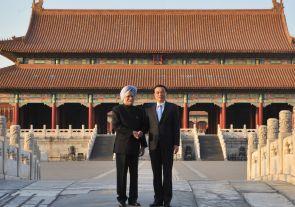
The Chinese premier’s visit will be a balm to India’s recent wound
http://www.outlookindia.com/article.aspx?285449


Chinese prime minister Li Keqiang’s visit to India is significant for three unique and 
outstanding reasons. First, it takes place soon after the recent 20-day faceoff in the 
western sections of the disputed border between the two sides. The fact that the visit 
is on shows that the top leaders of both countries are determined not to allow any 
dispute or difference to come in the way of their att­empts to build a strategic 
partnership. It also demonstrates that Sino-Indian ties are of strategic and global 
significance and go far beyond a bilateral relationship.

Given the lack of mutual acceptance or unified recognition of each other’s Line of 
Actual Control, there are scores of overlapping and grey areas with the potential for 
such face offs. It is also reasonable to assume, given the ground situation, that this 
kind of “incursion” must be occurring on both sides. The only difference could be 
that the Chinese media does not have easy access to reporting such “incursions”
by the Indian forces, whereas the Indian media is very vocal on the issue. But till 
the lac is finally identi­fied and is mutually accepted by both parties, such instances 
will remain all too frequent.

In the interim, however, there are several existing mechanisms which can help the two 
countries establish ‘guiding principles’ to settle border disputes. The manner in which 
they were used recently are a measure of the maturity the Sino-Indian ties have 
achieved.

Second, if it’s any encouragement, only once before have the heads of the Indian 
and Chinese governments visited each other’s country in the same year. (Manmohan 
Singh is scheduled to visit China later this year.) This was in 1954 when Chinese 
premier Zhou Enlai came to India in June and Prime Minister Jawaharlal Nehru 
returned the visit in October. Yet again, in the context of changing power equations 
in the global and regional arena, there is a strong demand from both sides to further 
upgrade the top-level interaction between the two countries.

The simultaneous rise of India and China, the global financial crisis and the economic 
recession as well as America’s ‘Asia-Rebalance’ strategy have infused a new dynamic 
into the Asia-Pacific region—where both China and India are located—and 
engendered uncertainty not only in the economic but also in the security domain.
It’s a scenario in which India and China can work jointly and constructively towards 
a much brighter future rather than wait for others to create a favourable external 
environment. In fact, the faster their rise, the greater the strategic squeeze and 
restrictions they are likely to face from the neighbourhood and developed economies. 
Both countries have the resources and the capacity to build a more inclusive, open, 
balanced and diversified framework in the Asia-Pacific region, both in terms of 
security and development, ensuring a win-win situation for both.

Leaders of China and India have often reiterated that there is enough space for the 
development of their countries. Both have had a long and rich civilisation to derive 
wisdom and philosophy from. The two nations also have a number of areas they can 
collaborate in. But without stra­tegic cooperation, such development and space could 
become restricted and congested. It could also lead to the competition becoming more 
vicious, and the more vicious it becomes, the less room there will be to develop. A 
collaborative approach, on the other hand, will help both countries grow.

Moreover, only by expanding their areas of cooperation and cultivating more common 
ground can the two countries reduce their differences—if not in absolute terms, then 
in relative terms. It could provide the constructive atmosphere in which both countries 
can step out of their straitjacketed thinking and come up with fresh solutions to disputes.

Third, his trip to India will be Premier Li’s maiden foreign visit after he became prime 
minister in March. Given that President Xi Jinping’s first visit was to Russia—another 
big neighbour—it’s clear that the new leadership in China is giving neighbourhood 
diplomacy top priority. Or at least that it regards relations with the neighbours to be as 
important as those with the US, for China’s peaceful development, especially as it 
faces troubled waters in the West Pacific region. 

Building a cooperative and 
harmonious neighbourhood is a must for China to be accepted as a benign rising 
global power. The Chinese dream cannot materialise if both the country and its 
neighbours spend sleepless nights. In fact, China needs to take initiative to promote
relations not just between China and its neighbours but among the nei­ghbours 
themselves. It can only bode well for Sino-Indian ties.


(The author is director, South Asia and Southeast Asian Studies, Chinese Institute for Contemporary International Relations, Beijing.)
__._,_.___