Tuesday, April 2, 2013


 Why China Is Reading Your Email: Timothy Thomas

Beijing's cyber attacks are rooted in military strategy, says one of America's foremost experts. The best way to combat them is for the U.S. to go on the cyber offensive too.

Timothy L. Thomas By DAVID FEITH

Fort Leavenworth, Kan.
For several years, Washington has treated China as the Lord Voldemort of geopolitics—the foe who must not be named, lest all economic and diplomatic hell break loose. That policy seemed to be ending in recent weeks, and Timothy Thomas thinks it's about time.
The clearest sign of change came in a March 11 speech by Tom Donilon, President Obama's national security adviser, who condemned "cyber intrusions emanating from China on an unprecedented scale" and declared that "the international community cannot tolerate such activity from any country." Chinese cyber aggression poses risks "to international trade, to the reputation of Chinese industry and to our overall relations," Mr. Donilon said, and Beijing must stop it.
"Why did we wait so long?" wonders Mr. Thomas as we sit in the U.S. Army's Foreign Military Studies Office, where the 64-year-old retired lieutenant colonel has studied Chinese cyber strategy for two decades. More than enough evidence accumulated long ago, he says, for the U.S. to say to Beijing and its denials of responsibility, "Folks, you don't have a leg to stand on, sorry."
U.S. targets of suspected Chinese cyber attacks include news organizations (this newspaper, the New York Times, Bloomberg), tech firms (Google, GOOG -1.06% Adobe, ADBE +2.00% Yahoo YHOO -0.26% ), multinationals (Coca-Cola, KO +0.55% Dow Chemical DOW +0.19% ), defense contractors (Lockheed Martin, LMT +2.17% Northrop Grumman NOC +0.36% ), federal departments (Homeland Security, State, Energy, Commerce), senior officials (Hillary Clinton, Adm. Mike Mullen), nuclear-weapons labs (Los Alamos, Oak Ridge) and just about every other node of American commerce, infrastructure or authority. Identities of confidential sources, hide-outs of human-rights dissidents, negotiation strategies of major corporations, classified avionics of the F-35 fighter jet, the ins and outs of America's power grid: Hackers probe for all this, extracting secrets and possibly laying groundwork for acts of sabotage.

China's aggression has so far persisted, Mr. Thomas says, because "it makes perfect sense to them." The U.S. has difficulty defending its cyber systems, the relatively new realm of cyber isn't subject to international norms, and years of intrusions have provoked little American response. "I think they're willing to take the risk right now because they believe that we can't do anything to them," he says. "You have to change the playing field for them, and if you don't, they're not going to change. They're going to continue to rip off every bit of information they can."
Hence the promise of Washington's apparent shift in policy. "There's something going on," Mr. Thomas says, and the Donilon speech was only one part. This month's more significant news, he argues, was the announcement that the U.S. military's Cyber Command (founded in 2009) would for the first time develop and field 13 offensive cyber-warfare teams. The Chinese "now know we are ready to go on the offense. There's something that's been put in place that I think is going to change their view."
Not that he expects Beijing to back down lightly. On the contrary, Mr. Thomas points to the literature of the People's Liberation Army to demonstrate that China's cyber strategy has deep—even ancient—roots.
The essence of China's thinking about cyber warfare is the concept of shi, he says, first introduced in Sun Tzu's "The Art of War" about 2,500 years ago. The concept's English translation is debated, but Mr. Thomas subscribes to the rendering of Chinese Gen. Tao Hanzhang, who defines shi as "the strategically advantageous posture before a battle."
"When I do reconnaissance activities of your [cyber] system," Mr. Thomas explains of China's thinking, "I'm looking for your vulnerabilities. I'm establishing a strategic advantage that enables me to 'win victory before the first battle' "—another classic concept, this one from the "36 Stratagems" of Chinese lore. "I've established the playing field. I have 'prepped the battlefield,' to put it in the U.S. lexicon."
Or, as Chinese Gen. Dai Qingmin wrote in his 2002 book, "Direct Information Warfare": "Computer network reconnaissance is the prerequisite for seizing victory in warfare. It helps to choose opportune moments, places and measures for attack." Says Mr. Thomas: "He's telling you right there—10 years ago—that if we're going to win, we have to do recon."
A 1999 book by two Chinese colonels put it more aggressively (albeit in a sentence as verbose as it is apocalyptic): "If the attacking side secretly musters large amounts of capital without the enemy nations being aware of this at all and launches a sneak attack against its financial markets," wrote Qiao Liang and Wang Xiangsui, "then, after causing a financial crisis, buries a computer virus and hacker detachment in the opponent's computer system in advance, while at the same time carrying out a network attack against the enemy so that the civilian electricity network, traffic dispatching network, financial transaction network, telephone communications network, and mass media network are completely paralyzed, this will cause the enemy nation to fall into social panic, street riots, and a political crisis." No kidding.
This vision from 1999 reads like an outline of the report published last month by Mandiant, a private-security firm, about "Unit 61398," a Shanghai-based Chinese military team that since 2006 has mounted cyber assaults to steal terabytes of codes and other information from U.S. assets. Among the targets of Unit 61398 was Telvent Canada, which provides remote-access software for more than 60% of the oil and gas pipelines in North America and Latin America.
Unit 61398 is said to engage in "spearphishing," whereby would-be cyber intruders send emails with links and attachments that, if clicked, install malware on target computers. Lesser hackers might spearphish while posing as Nigerian princes, but Unit 61398 developed sophisticated ways, including colloquial language, to mimic corporate and governmental interoffice emails.
Spearphishing, too, draws on traditional Chinese stratagems: "The Chinese strive to impel opponents to follow a line of reasoning that they (the Chinese) craft," Mr. Thomas wrote in 2007. With this kind of asymmetric approach, he says, "anybody can become an unsuspecting accomplice."
In this context Mr. Thomas mentions a cartoon published last year in Army magazine in which one Chinese general says to another: "To hell with 'The Art of War,' I say we hack into their infrastructure." Good for a chuckle, perhaps, but Mr. Thomas warns against taking the message seriously. China's hacking is in fact "a manifestation of 'The Art of War,' " he says, and if the U.S. military doesn't realize that, it "can make mistakes. . . . You have to stay with their line of thought if you're going to try to think like them."
"Boy," he later laments, "we need a lot more Chinese speakers in this country"—a point underscored by the fact that he isn't one himself. He reads Chinese military texts in translation, some published by the U.S. government's Open Source Center and some he has found himself. He stumbled upon Gen. Dai's "Direct Information Warfare" on a trip several years ago to Shanghai, when an associate led him (and an interpreter) to an unmarked military bookstore on the top floor of a building on the outskirts of town. "I could tell when I walked in that the people behind the cash register were stunned I was there," he recalls. In public bookstores, he says, material addressing Chinese national security is often marked "not for foreign sale" on the inside cover.
The Ohio native does speak Russian, having focused most of his military service (from West Point graduation in 1973 until 1993) on the Soviet Union. That language skill still comes in handy, and not just because Russia is suspected of having carried out cyber assaults against Estonia in 2007 and Georgia in 2008.
Look at the Mandiant report's map of Chinese cyber intrusions (at least those tied to Unit 61398): Russia is untouched. "That's a huge area. . . . I really would wonder why they're after South Africa, the U.A.E. and Singapore but not Russia. And Luxembourg. They went after Luxembourg but not Russia?" Together with Iran, he argues, China and Russia make up "not the axis of evil but the axis of cyber."
So what is to be done? Security firms are working to harden networks against hackers, and members of Congress are promoting legislation to let the government work more closely with Internet service providers without opening up the companies to lawsuits or infringing on civil liberties. Washington could challenge Chinese cyber espionage with targeted economic sanctions. Meanwhile, there is much talk about establishing international standards for cyber space, but it is unclear what that would mean—which probably explains why top officials in Washington and Beijing have both endorsed the idea.
None of this seems promising to Mr. Thomas, who stresses building deterrence through offensive capabilities, such as the 13 new teams at U.S. Cyber Command. The implication is that the best defense is a good offense.
And doesn't that suggest, in turn, that the U.S. and China are headed toward a dynamic of mutually assured cyber destruction? "It seems like it," he says.
It's heartening to hear, then, that Chinese military literature isn't uniformly aggressive toward America. This includes writings about the "China Dream," which posits that China will overtake the U.S. economically and militarily by midcentury—and which has been adopted as the signature cause of new President Xi Jinping.
"They give you both versions," says Mr. Thomas. "They give you a model that says, 'There will be no way we'll ever fight [the U.S.], we'll work on cooperation.' A chapter later, 'There could be a time where if pushed hard enough, we'll have to do something and there will be a battle.' "
But what about the argument that the U.S. is shedding crocodile tears? America (and Israel) were almost certainly behind the most successful known cyber attack to date: the Stuxnet virus that impeded Iran's uranium-enrichment program. There might be some comfort in knowing that the U.S. is doing unto China what China is doing unto the U.S., says Mr. Thomas, but "we don't seem as intrusive as the other side." That is illustrated especially, he says, by China's state-sponsored commercial espionage. He frequently hears complaints from U.S. firms dealing with Chinese counterparts who know their secrets, adding that "I don't think people really get the security briefing of just how invasive it is."
Then there's the argument that all this is overblown because no cyber attack has ever killed anyone. Mr. Thomas responds, somewhat impatiently: "If I had access to your bank account, would you worry? If I had access to your home security system, would you worry? If I have access to the pipes coming into your house? Not just your security system but your gas, your electric—and you're the Pentagon?"
He adds: "Maybe nobody's been killed yet, but I don't want you having the ability to hold me hostage. I don't want that. I don't want you to be able to blackmail me at any point in time that you want." He cites the Chinese colonels' vision, back in 1999, of "social panic" and "street riots." "I wonder what would happen if none of us could withdraw money out of our banks. I watched the Russians when the crash came and they stood in line and . . . they had nothing."
Mr. Feith is an assistant editorial features editor at the Journal.
A version of this article appeared March 30, 2013, on page A11 in the U.S. edition of The Wall Street Journal, with the headline: Why China Is Reading Your Email.

India must look North-East

Monday, 01 April 2013 | KG Suresh | in Oped


http://www.dailypioneer.com/columnists/oped/india-must-look-north-east.html

The reason why the legendary freedom-fighter from Meghalaya, U Kiang Nanbah, is an unknown figure for the rest of the country is that we are so poorly informed about the history and culture of the Seven Sisters

At the first instance, the name struck as perhaps one of some South East Asian political leader. It was later one realised that he was one of the greatest freedom-fighters this country has produced. Unfortunately, not only in the rest of the country but even in his own native Meghalaya, U Kiang Nanbah is not a well-known figure, thanks to a policy of sheer indifference successive Central Governments have adopted towards the history and culture of the people of the North-East,
Remembering Nanbah now assumes all the more significance as 2013 marks 150 years of his execution at the hands of the British rulers. Not much is known about his early days except that he was a child when the British annexed the Jaintia kingdom in 1835. He had no royal lineage whatsoever and was born in an ordinary peasant family, but what ignited the spirit of patriotism in the young Nanbah was the high-handedness of the alien rulers and the daredevil exploits of his maternal uncle U Ksan Sajar Nangbah, who fought against the invaders at a place called Chanmyrsiang.
Like in other places, the British initially adopted a policy of least interference in the internal affairs of the newly annexed kingdom, but gradually started imposing taxes and restrictions on the religious beliefs and cultural practices of the locals, which was resisted by Nanbah and his many compatriots.
The movement against the aliens intensified after they set up a police station at Jwai in 1855 to establish “Government authority” over the hills. The establishment of the military outpost near the cremation grounds of the Dkar clan and  orders restricting the burning of the dead was seen as interference in religious beliefs and fuelled popular resistance against the British.
The establishment of a missionary school, the destruction of weapons ahead of a traditional ceremony and attempts by British-supported missionaries to slam the beliefs of the locals as superstitions added fuel to fire. U Kiang emerged as the leader of the resistance movement and led the attacks on the Jwai Police Station, which was totally destroyed. Subsequently, the group burnt down the Christian settlement and besieged the military post. The resistance was so fierce that the British had to rush in reinforcements and launch full-scale military operations against U Kiang and his men. Unfortunately, U Kiang fell ill and was finally nabbed after stiff resistance, with the help of informers.
This revolutionary leader was put on mock trial and was sentenced to death within three days of his capture, before the very eyes of the locals, to send across a tough message that any resistance to the British rule would not be tolerated and would be suppressed with an iron hand.
However, as he was being taken to the gallows on the evening of December 30, 1862, U Kiang said something prophetic, “Brothers and sisters, please look carefully on my face when I die on the gallows. If my face turns towards the east, my country will be free from foreign yoke in the next 100 years and if it turns west, it will remain in bondage for good.”
In less than a century, India became independent. Like the native American Indians, U Kiang fought for the rights of the people in the face of imposition of an alien way of life and values. People of Khasi and Jaintia Hills have since lost much of their traditional culture. In fact, not many in the younger generation even remember U Kiang Nanbah.
The ignorance about U Kiang Nanbah is a reflection on the Government’s education policy, which has totally neglected the history of the North-East. Forget Nanbah, most history textbooks prescribed by the Central Board of Secondary Education do not have any reference to the history, culture or traditions of the region. It seems as if their history begins with the British annexation of their territories. A serious attempt was made in this direction under the leadership of the then National Council of Educational Research and Training Director, JS Rajput, during the NDA regime, but hundreds of textbooks prepared during the time were later thrown into the dustbin under the garb of preventing ‘saffronisation’ of education.
Even 65 years after independence, people from the North-East continue to be clubbed together and singled out, and that too for their racial features. Often, they are mistaken as Chinese, Nepalese or from South East Asia, and referred to even by the educated as ‘Chinkies’ because of their Mongoloid features. Forced to migrate from their idyllic but underdeveloped States for education and job opportunities, these people, mostly women and youngsters, are not only discriminated against but also have often been victims of eve teasing, molestation and rape. What’s more, they also find themselves at the receiving end of the utterly insensitive law enforcement agencies. This has led to a sense of alienation among these people, many of whom have become susceptible and vulnerable to propaganda by the separatists.
While sociologists, politicians and commentators have been attributing it to factors including the insensitivity and conservatism of the North to the lack of infrastructure and employment opportunities as also massive corruption in the North-East, resulting in migration, the fact remains that the wide communication gap between the peoples of the region and the rest of India, as well as ignorance about each other, have significantly contributed to this crisis.
Not that have there not been efforts to build bridges of understanding between the North-East and the other parts of the country, but the few attempts that have been made are few and far between. Few Gandhians, some Hindi activists, initiatives such as Ekal Vidyalaya, Vanvasi Kalyan Ashram, Ramakrishna Mission, cultural centres of the Union Government and even State-controlled media, have been contributing their bit in this direction.
There have been some citizen-driven initiatives such as My Home India, run by Mumbai-based social activist Sunil Deodhar, which seeks to bridge the chasm by helping students and others from North Eastern region in metropolises such as Mumbai and Delhi, in their hour of need. “We not only strive to help the people from the North-East but also sensitise locals about the beautiful region”, says Deodhar.
Nevertheless, this sensitisation has to begin from the school level itself, and that can be made possible only by incorporating the history, culture and traditions of the North-East in social studies textbooks taught across the country. There cannot be a greater and better opportunity to reach out to the people of the North-East than by observing the 150th anniversary of U Kiang Nanbah’s martyrdom. This can be done with the active involvement of the people of the region and by educating the rest of the country about the contributions made by the freedom-fighters, intellectuals, artists and sportspersons from the North-East towards the building of a modern India.
(The writer is a senior journalist based in Delhi)

On China’s State-Sponsored Amnesia

http://www.nytimes.com/2013/04/02/opinion/on-chinas-state-sponsored-amnesia.html?pagewanted=1&_r=0

Cristóbal Schmal
By YAN LIANKE
Published: April 1, 2013
Beijing
IN March 2012 I met Torbjorn Loden, the Swedish professor of Chinese language and culture, in Hong Kong. He told me that while briefly teaching at Hong Kong’s City University he asked the 40 students from China in his class what they knew about the June 4 Incident, the pro-democracy movement that ended in bloodshed in 1989, and if they were familiar with the names Liu Binyan and Fang Lizhi, two prominent democracy advocates of that era. All the students from China looked around at one another, mute and puzzled.
That reminded me of something another teacher told me. She had asked her students from China if they had heard about the death by starvation of 30 to 40 million people during the so-called “three years of natural disasters” in the early 1960s. Her students responded with stunned silence, as if she, a teacher in Hong Kong, was brazenly fabricating history to attack their mother country.
After we exchanged these stories, Professor Loden and I sat sullenly in a quiet Vietnamese café, speechless. Ever since, thoughts about the loss of memory in China on a national scale, a phenomenon that people have long been discussing but only in private, remain lodged in my heart like thorns. From time to time, guilt — along with painful memories of the past and thoughts about losing the memories — torment me and refuse to leave me alone.
Have today’s 20- and 30-year-olds become the amnesic generation? Who has made them forget? By what means were they made to forget? Are we members of the older generation who still remember the past responsible for the younger generation’s amnesia?
The amnesia I’m talking about is the act of deleting memories rather than merely a natural process of forgetting. Forgetting can result from the passage of time. The act of deleting memories, however, is about actively winnowing out people’s memories of the present and the past.
In China, memory deletion is turning the younger generation into selective-memory automatons. Memories of history and the present, yesterday and today are all going through this uniform process of deletion and are being lost without trace.
I used to assume history and memory would always triumph over temporary aberrations and return to their rightful place. It now appears the opposite is true. In today’s China, amnesia trumps memory. Lies are surpassing the truth. Fabrications have become the logical link to fill historical gaps. Even memories of events that have only just taken place are being discarded at a dazzling pace, with barely intelligible fragments all that remain for people to hold on to.
Revolution completely engulfed China after 1949. The revolution created the regime, created history, and it created our present reality. People’s memories and administered memories, people’s forgetfulness and administered forgetfulness are all determined by the state, transformed by a revolutionary tactic that has been systematically implemented.
Historical details are selectively excised from the records and from textbooks. Details of events that still reside in the living memory of older Chinese — the Warlord era of the late 1910s and 1920s, names of soldiers and civilians who shed their blood on the front lines during the war of resisting Japan’s invasion that began in the 1930s — all these things have been carefully winnowed.
After the civil war ended in 1949, one man’s passion drove an entire nation to a frenzied pace of construction, with one political movement after another maintaining the fanatical atmosphere of a permanent war footing.
But the tragic experiences associated with these movements have been deleted from people’s collective memory, put aside and permanently concealed.
The Great Leap Forward, the obligatory nation-wide construction of backyard steel furnaces and the consequent death by starvation of 30 to 40 million people in the famine that was later blamed on “three years of natural disasters,” and the catastrophic 10 years of the Cultural Revolution — these momentous events are too absurd, too cruel and too unpleasant for people to recount. Therefore many people are reluctant to pass their painful memories on to the younger generation.
Not a word is written about how many Chinese, or Vietnamese, died in the pointless war with Vietnam in the late 1970s. Few questions are asked about the crackdown on criminals in 1983 in which people were thrown in jail in the name of curtailing public indecency simply for kissing in public, or executed for poverty-related petty theft.
While the whole world still vividly remembers the tragic end of the June 4 student movement in 1989, the painful memory is lost in the country where the bloodshed took place, in the midst of cheers for China’s economic growth and increased influence.
What else is lost to memory? Everything that has happened in recent times: the AIDS epidemic caused by unhygienic blood selling; the innumerable explosions in illegal coal mines; the modern day slavery that takes place in illegal brick kilns; the rampant production of toxic milk powder, toxic eggs, toxic seafood, gutter oil, carcinogenic vegetables and fruit; forced abortions; violent demolitions; mistreatment of petitioners — the list goes on and on.
Anything negative about the country or the regime will be rapidly erased from the collective memory. This memory deletion is being carried out by censoring newspapers, magazines, television news, the Internet and anything that preserves memories.
This amnesia with Chinese characteristics doesn’t just affect individuals, it also affects China as a nation. Some people say, “Let bygones by bygones, we must look forward.” Consolation, perhaps, for an individual’s suffering, but it is no consolation for an entire people’s loss of memory.
Others say “If we don’t look forward, we won’t have a bright future.” This might be a good piece of advice for people who hide in the past, but it is hardly constructive for people who surrender themselves to memory deletion.
This state-administered amnesia is similar to territorial defense in the animal kingdom. It’s about survival.
The best way to achieve this type of amnesia is to develop tactics utilizing state power to shackle people’s minds and block all memory channels by altering historical records, manipulating textbook content and controlling literature, art and performances in all forms.
The oppression of words and ideas is not unique. It has been exercised by all authoritarian regimes around the world at various times. Under oppression, intellectuals — the people who are supposed to have good memories — are the first to become silent after being administered amnesia by the state. Next comes the general public.
The state prefers the intelligence of its people to remain at the level of children in a kindergarten. It hopes people will follow instructions, just as children follow their teacher’s instructions — they eat when they are told to eat, they sleep when they are told to sleep. When they are asked to perform, these innocent children enthusiastically recite the script prepared by adults.
To achieve this, the brains of people who have memories must be reformatted, voices of people who are good with words must be silenced, so that the memory of younger generations won’t be contaminated.
Then these spotlessly “clean” young brains are like blank pages at the disposal of the state’s paintbrush. Only then can a new version of history and a new image of reality be painted on these pages according to the taste of the state.
Naturally, the innocent children who have been deprived of the chance of knowing what really happened in the past accept the artificial version of history and grow up malnourished in their understanding of the past. As time goes by, the state’s absolute power becomes a matter of fact and this marks the triumph of state administered amnesia.
Our tolerance to this type of amnesia originates from the state’s carrot-and-stick strategies that are designed to achieve the nation’s memory loss.
Thirty years ago, the instruments used against people who resisted state-sponsored amnesia were ropes and chains. Now, as China’s economy grows and the state has an enormous amount of money at its disposal, it skillfully uses financial incentives to entice people into giving up their memories and to compromise with the state. In this country money now has an almighty power that can seal people’s lips and dry writers’ pens. It can also force literary imagination to fly in the opposite direction of truth and conscience.
It doesn’t matter whether you are a writer, a historian or social scientist. You will be awarded power, fame and money as long as you are willing to see what is allowed to be seen, and look away from what is not allowed to be looked at; as long as you are willing to sing the praises of what needs to be praised and ignore what needs to be blanked out. In other words, our amnesia is a state-sponsored sport.
Let’s look at literature and art. Almost all awards in China in the fields of literature, art, news and culture are administered within state-approved boundaries. They encourage people to exercise their creativity within the state-approved boundaries. The ones who achieve success within these boundaries are rewarded. Naturally, we thus replace the forgotten past with fiction and build splendid lies over reality. And we do this without feeling any sense of moral guilt — it’s all in the noble name of artistic creativity.
Consequently, truth is buried, conscience is castrated and our language is raped by money and power. Lies, meaningless words and pretentious-sounding blather become the official language used by the government, taught by our teachers and adopted by the world of art and literature.
This kind of language is also creeping into the lives of ordinary people. There are currently two conflicting language systems in China. One belongs to the state, the other to ordinary people.
Why? Why are ordinary people repeatedly calling for government officials to “speak human language” and “do human things”? These requests reflect people’s resistance to the official version of memories that has been administered to them.
The state is not the only player to be blamed for the nation’s amnesia in today’s China. We must also look at Chinese intellectuals, as we appear to be content with this forced amnesia.
This is the starkest difference between Chinese intellectuals and our peers in other countries in different times. Take writers in the former Soviet Union as examples. Despite the extreme totalitarian terror and the rigid censorship, writers such as Mikhail Bulgakov, Aleksandr Solzhenitsyn and Boris Pasternak still managed to leave us with a long list of masterpieces such as “The Master and Margarita,” the “Gulag Archipelago” and “Doctor Zhivago.” These works did not rebel against state power; they are more about preserving and restoring a nation’s memories.
Today’s China is no longer a hermetically sealed nation as it was just a few decades ago. The economic window in China is wide open to the world now. The other window, however, the political window, is still tightly shuttered, because the state is determined to cling to its power to control. And the secret of state-administered amnesia with Chinese characteristics lies in the different condition of the two windows. The mind of the state is keeping a watchful eye on the windows and what people are writing, but no one is allowed to keep a watchful eye on the mind of the state.
Our acceptance of state-administered amnesia can be seen as a tacit understanding among men of letters who appease the state’s power. It is a wise man’s compromise — after all, one of the windows is open. Light is allowed in. Our world is brighter than before.
In this part of the world laws don’t mean much when it comes to preserving our memory and preventing amnesia. They don’t protect our freedom of speech, freedom of information or freedom of publication, nor do they protect people’s rights to remember what happened in the past.
Everything depends on our leaders’ morals and how open-minded these leaders are. The one opened window we have now is more a small mercy bestowed by the powerful at a permissive moment, than a victory won by intellectuals because of our persistent quest for openness.
Someone who has spent years in a dark cell is bound to be grateful if a window in his cell is unshuttered and some light is allowed in. Would he dare to ask for the prison gate to be opened for him? At least today we are allowed to breathe some air, so what’s the point of sacrificing ourselves for a breeze that might come tomorrow — that’s the reasoning behind the silence of Chinese writers and intellectuals in the face of state-administered amnesia.
Gradually we become accustomed to amnesia and we question people who ask questions. Gradually we lose our memories of what happened to our nation in the past, then we lose the sense of what’s happening in our nation at present, and, finally, we run the risk of losing memories about ourselves, about our childhood, our love, our happiness and pain.
Yet, just as in any kindergarten, there are always a few naughty children who don’t like to be told what to do. There are always some people who refuse to be administered amnesia. They are always trying to speak in their own words, always spreading their creative wings to fly beyond the boundaries of official memory. Following their conscience, they are willing to fly anywhere, into the past, the present or the future, in order to produce works that can pass our memories onto younger generations.
Of course, whether or not a piece of art or a literary work can carry our memories is not the only thing that needs to be considered when we judge the quality of a work. However, whether preserving memory is allowed is the most valuable parameter to measure the greatness, maturity and degree of tolerance of a nation.
It has been over 30 years since China opened its economic window. China now is more prosperous and is stronger than it was 30 years ago. I believe China should also be mature enough to reflect on and remember its past.
The late Chinese writer Ba Jin had a dream for preserving memory — to build a museum in China devoted to the Cultural Revolution, the “revolution” that took place in the 1960s and 1970s and turned the nation into a madhouse.
Carrying on Ba Jin’s dream, I also have a naïve hope: I hope one day a memorial to amnesia engraved with all our nation’s painful memories of the last century can be erected on Tiananmen Square.
I believe a truly great people are people who have the courage to remember their own past, and a truly great nation is a nation that has the courage to record its own history.

Yan Lianke is a Chinese writer based in Beijing. His translated works include “Serve the People,” “Dream of Ding Village,” about the blood-selling scandal in his home province of Henan, and “Lenin’s Kisses.” This article was adapted from a longer essay and translated from the Chinese by Jane Weizhen Pan and Martin Merz. A German version of the essay appears in the spring issue of Lettre International. 

Invention of the Day: A Bladeless Windmill

Invention of the Day: A Bladeless Windmill

It may look like a giant airplane window strung with Venetian blinds, but this structure, designed by Dutch architecture firm Mecanoo and installed at the Delft University of Technology this month, is a model of a machine that would convert wind to energy without any moving parts.
Any mechanical moving parts, at least: the technology, developed by the Electrical Engineering, Mathematics and Computer Science faculty at Delft, uses the movement of electrically charged water droplets to generate power. How does this work? A handy video explains:

The prototype of the EWICON (Electrostatic Wind Energy Converter), as envisioned by Mecanoo, has the potential to change the use of wind technology. The EWICON absorbs little wear and tear, requires hardly any maintenance, but most importantly, it makes no noise and casts no moving shadows, two of the principal complaints that hinder windmill installation in the United States.
This, Mecanoo believes, makes it the ideal feature for urban environments -- they've already incorporated them into their design for a project in Rotterdam.
Top image courtesy of Mecanoo Architects.
HT: Designboom.
Henry Grabar is a fellow at The Atlantic Cities. All posts »

How not to deal with defence corruption

Sunil Dasgupta and Stephen P. Cohen; Tue Apr 02 2013


INDIAN EXPRESS DATED 02Apr 2013

The problem is not foreign suppliers, but a dysfunctional defence marketplace

The furore over the latest arms procurement scandal in India — this time over the AgustaWestland helicopters — has led, predictably, to calls for greater indigenisation of the military industrial complex, as if excluding foreign weapons-makers will clean up the corruption.
The problem is not foreign suppliers, but a defence marketplace where domestic industry produces low-quality weapons at great cost, often late, which India's armed services do not want. To the extent that foreign suppliers act in venal manner, it is because India's defence marketplace is dysfunctional. Excluding foreign sellers only reduces the number of players and externalises the problem; it does not stop corruption.
The so-called "China solution," which lauds Beijing's success in weapons development and manufacture, is misconstrued: China's self-reliance has not produced new conventional weapons. Chinese aircraft, tanks and ships are quite ordinary platforms.
Its successes in nuclear, missile, laser, and cyberwar technologies are all unconventional. The causes of Chinese successes in unconventional military technologies are many, but it is worth remembering that the Chinese government has used an extensive spying campaign in pursuit of commercial and military secrets. This consequences of the campaign are now catching up with Beijing as the United States and other Western powers gear up to prevent Chinese infiltration.
As an emerging power, India is better off being seen as a benign force. It is better off buying technology rather than stealing it. It is better off inviting the world to participate in its rise than keeping the world outside and suspicious. Better off acting transparently in the defence marketplace even at the cost of sacrificing secrecy. Better off reforming its procurement system, rather than winnowing down the market. India buys weapons from foreign suppliers not only to develop military capacity but also to build relationships with other key countries that facilitate its rise.
The key instrument of economic efficiency in any market, pricing, is mind-bogglingly inefficient when it comes to armaments. Weapons in the same category made by different manufacturers are not readily comparable, especially at the higher rungs of the technology ladder. There are too few sellers and even fewer buyers to make a truly competitive market. Further, the value of a particular weapon-system in the context of a national security strategy is hard to calculate. Try, for example, figuring out whether missiles or attack aircraft have greater utility; practically every government faced with the decision went with both, the most expensive and least efficient option.
India's defence market faces these challenges and more. We argued in our book Arming without Aiming that Indian military procurement is disconnected from national objectives. Indian grand strategy de-emphasises the use of force and consequently, the military receives little strategic guidance from the political leaders. Prime Minister Manmohan Singh, for example, has repeatedly said at conferences with Indian military commanders that the country's primary threats are internal, without publicly clarifying the role of the armed forces in meeting internal security challenges. Only the Indian army participates in internal security operations, that too, in well defined areas such as Kashmir; what should the Indian Air Force and the Indian Navy do? According to the Constitution, the armed forces are not responsible for internal security. The police, which is responsible for domestic law and order, remains in the hands of the states and outside the ability of the Central government to reform.
On the military side, the result is that the services are left to define the threats they believe the country faces and accordingly they appear to be preparing to fight three different wars against three different enemies.
Today, the army thinks it needs an air force of its own, the navy wants to acquire its own thermonuclear capability, and the IAF appears to be planning for wars independent of the other two services.
India was one of the first countries in the world to integrate officer training — at the NDA and the Staff College — but everything else seems to be contributing to service rivalries.
India's unified commands are feeble and there is no movement on a new combined defence chief. Only actual wars and initial setbacks seem to produce inter-service cooperation, such as between the army and the IAF in Kargil.
The problem is exacerbated by the lack of military expertise in the political and bureaucratic class. Several retired defence secretaries we spoke with during the course of writing Arming without Aiming reported that it was not until their second or third postings in the ministry that they had acquired a sense of competence in the field.
Arun Singh, one of the more respected defence ministers in Indian history, once proposed keeping certain IAS and IFS officers in defence-related positions for much of their careers — in effect creating a specialist cadre within the civilian bureaucracy. Another option might be to bring in outside civilian experts from the academy or journalism into government for short-periods of time like in the American system, but the thought of lateral entry into the civil service, or a defence cadre within the IAS, remains unthinkable.
The Indian defence industry is largely state-owned and has its own problems of bias and corruption that result in cost and quality losses for the armed forces. The DRDO and the defence public sector units operate as a monopoly with attendant failures in innovation, cost, and accountability. The scientific advisor to the defence minister, who shapes procurement decisions, also heads the military research labs, which puts him in the position of evaluating his own work in comparison with those of others. This conflict of interest is not even seen as a source of corruption.
The continued absence of Indian firms in the defence marketplace reflects a deep-seated ideological bias against profit as a motive for productive action. The expectation that Indian private industry, if allowed entry into the military production, will be less corrupt is misguided as well. Doubtless, the government will have greater control over an Indian seller than it does over a foreign supplier, but the actions of businesses alone do not cause corruption; government officials have to take bribes. There is no reason to expect that Indian firms will not be asked to pay up to win contracts.
These dysfunctions persist behind the trope of secrecy. Military-strategic matters are national secrets no doubt, but the process of buying weapons (that are already owned by other countries) hardly needs to be conducted in secret. Similarly, the DRDO, which is not building any unheard of weapon-system, should conduct itself in full public view and allow its scientists to join the peer review system. Closed-off organisations generally fail to innovate; little wonder that only 3 per cent of DRDO scientists and engineers have PhDs. Opening up the military research and weapons procurement process to public view would reduce the potential for corruption, and it would not be worse than the present glacial acquisition process.
Indian defence badly needs reform, but the recommendations of several high-powered committees — including those headed by Arun Singh, Naresh Chandra and the irreplaceable K. Subrahmanyam (Kargil review) — remain ignored by several governments. India needs to begin at the beginning, with a clearer vision of the role of the military and use of force in the country's rise as a great power.
This vision must balance between domestic and external threats to security, include non-military challenges, push through difficult reforms to enhance harmony across government agencies and departments and welcome transparency. With defence matters not on the electoral agenda, we are not very hopeful this will happen without the shock of another crisis.
Dasgupta is a non-resident senior fellow at the Brookings Institution, Washington DC. Cohen is senior fellow, foreign policy, at Brookings


1965: General Chaudhury did not order withdrawal behind River Beas
IDR
Issue Net Edition | Date : 01 Apr , 2013


Forty seven years have passed since the 1965 war with Pakistan, still controversies and confusion on many issues and events persist. It is so because the official history of this war is shrouded in secrecy. The documents with the MOD, MEA, RAAW, IAF and army formations are yet to be declassified. Given this blanket blackout of authentic information, hearsay, gossip, speculation, calumny continue to be floated and controversies abound.
The one controversy that seems to have nine lives is the alleged order by General Chaudhury, the then COAS to Lt-Gen Harbaksh, Western Army Commander, to pull his troops behind Beas river
The one controversy that seems to have nine lives is the alleged order by General Chaudhury, the then COAS to Lt-Gen Harbaksh, Western Army Commander, to pull his troops behind Beas river. Inder Malhotra, in an article in a national daily, added his bit to this controversy. He records that, once General Chaudhry came to know that Pakistan has two armoured divisions, ‘he panicked and ordered Harbaksh to withdraw his troops behind Beas, and the latter refused.’ He goes on to add that it was the Maharaja of Patiala who prevailed upon Chaudhry not to insist on Harbaksh to carry out this order. However, Malhotra does not elaborate as to how a maharaja ( then a captain and ADC to Harbaksh ) came in between the army chief and his army commander concerning an order of far reaching consequences at a critical stage of the battle. He also does not seem to know that, the existence of second armoured division with Pakistan was known to army HQ well before the war.
K Subramanyam, a defence commentator of considerable repute and former director of IDSA, in an article, stated that Gen Chaudhuri had sought Prime Minister Lal Bahadhur Shastri’s permission to withdraw troops behind Beas and that the PM did not permit him to do so.  This version too, is seriously flawed and contradicts one by Malhotra. If Chaudhuri first approached the PM and drew a blank, he could not have passed such an order to Harbaksh. If he had spoken to Harbaksh first and got a response that there was no need for such a move, he could not have approached the PM on this issue. A catch 22 situation!
 This story of Chaudhury’s order and Harbaksh’ refusal is baseless and to support it is to display complete lack of understanding of conduct of operations.
This story of Chaudhury’s order and Harbaksh’ refusal is baseless and to support it is to display complete lack of understanding of conduct of operations. The assessment of the situation at army HQ is based on information and assessment sent to it by command HQ  etc. Unless those in contact with the enemy paint a very grim picture of the developments at the front and the command’s assessment is that the existing positions have become untenable and a withdrawal to the rear has become imperative, why should army HQ contemplate withdrawal! The army chief cannot possibly take a decision of such, far reaching consequences, without a detailed discussion with his Director General Military Operations (DGMO.) and the concerned army commander. In this case the then DGMO, Maj-Gen Narinder Singh rubbished this story of withdrawal and termed it as baseless.
Gen Harbaksh in his book, ‘War Dispatches’ and his chief of staff, Maj-Gen Joginder Singh in his book, ‘Behind the Scene’ makes no mention of any order or suggestion from the chieffor a pull back behind Beas. September, 9th and 10th were the critical days during the battle at Khem karan. On 10th Sep Gen Chaudhury moved forward and conferred with Gen Harbaksh at Ambala to take stock of the situation. Harbaksh’s chief of staff and Chaudhuri’s MA were present at this meeting.  Harbaksh in his book ( page 60) gives details of the discussions with the army chief, but there is no mention of any suggestion of a pull back behind Beas. Chaudhuri’s MA too maintained that at no point of time did the army Chief contemplate a withdrawal behind Beas. This story of falling back on Beas is the figment of Malhotra’s and Subramaniam’s imagination.
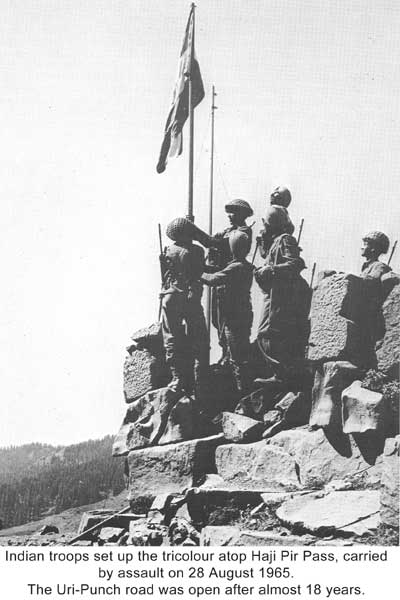
The war with China in 1962 had shifted India’s focus to that front, relegating capabilities against Pakistan. Indian tank fleet numbered 608, majority being of Second World War vintage, 625 artillery pieces and 35 infantry brigades for the Western front. Against this Pakistan had 765 tanks (including 352 state of the art Patton tanks) 552 artillery pieces, 26 infantry brigades and 9000 Razakars. Pakistan had two armoured divisions against one with India. Their guns had better range and higher caliber. Gen Chaudhury, soon after the Run of Kutch incident had warned his army commanders that, Pakistan could force a war on India. The last minute raising of HQ 1 Corps and 14 Infantry Division in May-June 1965 needs to be seen in this light. The Government of India expected no threat from Pakistan and was not prepared to spend any more funds on defence.
…Chaudhury adopted the strategy of offensive – defensive. Defence in the Punjab and offensive in the plains sector of J and K.
The relative strength was decidedly against India going over to the offensive, but there was no other option. Therefore, Chaudhury adopted the strategy of offensive – defensive. Defence in the Punjab and offensive in the plains sector of J and K. In Punjab it was to carry the war into Pak territory and take up defences based on the East bank of Ichugal canal.  India had no obstacle of its own. In the Punjab sector, though complete surprise was achieved and the task was simple, yet there were failures, which led to a crises situation in the Khem Karan sector.  It was the brilliant strategic concept of Gen Chaudhuri, that brought about destruction of Pakistan armour by an inferior tank fleet.
Malhotra alleges that the army chief had not bothered to take the IAF into confidence. Further that the fall of Akhnoor would have resulted in cutting off Kashmir from the rest of India. On both these points he is completely off the mark. Gen Chaudhuri learnt of Pak offensive on 1 Sep while he was in Srinagar. He and his DGMO flew to Delhi arriving there at mid-day. At 3 PM the army chief briefed the PM, RM, FM, the Chief of the Air Staff and others in the army HQ Operations Room on the situation and highlighted the imperatives of opening another front across the IB to relieve pressure from the Akhnoor sector. The IAF representatives at HQ 15 Corps (J and K) and HQ Western Command were fully aware of the details of PAK offensive in Chamb sector. In any case on 1 Sep, the IAF inflicted heavy damage only on own troops and not the enemy. This was mainly due to lack of joint training. Therefore, to contend that it is the IAF that stabalised the situation on 1 Sep is wrong.  Further his contention that fall of Akhnur would have cut off J and K from rest of India only shows his lack of knowledge of geography of J and K.
Malhotra’s figure of only 8 percent expenditure of ammunition by India is of his own imagination.
.Air Marshal Noor Khan of Pakistan Air Force, in his book has recorded that Pakistan army’s ammunition finished on the second day and Inder Malhotra says that, ‘Pak had run out of ammunition by the time of the cease-fire.’ Those who took part in this conflict would recall that, throughout the war they were subjected to intense shelling by the Pakistan artillery; the heaviest firing being after the cease-fire. By the end of the war, Indian army’s ammunition stocks were never alarmingly low. Malhotra’s figure of only 8 percent expenditure of ammunition by India is of his own imagination.
Pakistan did not expect India to retaliate across the International Border, because it had confined the conflict to CFL, (Chamb sector) as a mere counter to Indian actions across this line elsewhere in J and K. That was the logic that worked on the Pakistani mind, reinforced by perceptions of Indian capabilities; military and political. Given this background, Indian offensive across the IB caught Pakistan completely by surprise. However, the Indian army’s preparations for the offensive between 1 and 5 Sep, the side-stepping of armoured division from Amritsar sector to Jammu and maintaining complete surprise, was no mean achievement.
Though, Malhotra in his recent article in the Indian Express terms Indian army’s success in this war as, “marginal victory.” The point never understood by many is that due to high value targets close to the border neither side was willing to concede territory and therefore, pitched battles took place within few kilometers either side of the border. That was and will remain the dominant reality of any fighting in the plains sector of J and K and the two Punjabs.
It goes to the credit of those who planned the war strategy and others who took part in it, that inspite of being a weaker force, Indian army got the better of Pakistani troops and when the war ended they were decidedly and decisively on top. However to lift the prevailing fog, the entire records pertaining to this war need to declassified to place events and actions in their correct perspective. Only then will there be an end to disinformation and calumny. Gen Chaudhury was a brilliant strategist and Harbaksh a great field commander. These controversies do injustice to them and belittle Gen Chaudhury’s services to the nation.
Rate this Article

About the Author


Reload the Indian Economy-1991 reloaded
 
THE HINDU, March 31, 2013T. C. A. Srinivasa-Raghavan

In the 22 years since the last major crisis, the economy is right back where it started.
Finance Minister P Chidambaram has said he can see some green shoots in the Indian economy. Of late it has been as barren as Caesar’s wife Calpurnia.
GDP growth has come down from around 9 per cent to well below 6 per cent in a scant three years.
Investment is hugely down, from 38 to 26 per cent of GDP, and no amount of pulling on the corporate udder is getting it to yield milk.
Inflation remains high, around 13 per cent for consumers who are sullenly waiting to get rid of Sonia’ Sorry Army.
The current account deficit has just gone well above 6 per cent which could lead to foreign money withdrawing from India.
And political uncertainty engulfs the country like the January fog in Delhi.
Is it any wonder that the economy is not taking off?
The imminent crisis
It is the job of finance ministers to hold out hope. After all, they can hardly say that the end is nigh.
But governors of central banks have to be more circumspect. That is probably why Governor Subbarao spoke very guardedly about the green shoots during his I G Patel Memorial Lecture at London School of Economics.
This is what he said: “…There is nothing inevitable about the India growth story. We can accelerate growth and improve welfare only if we effectively implement wide ranging economic and governance reforms. Slipping up on this will amount to a costly and potentially irreversible squandering away of opportunities.”
He then went on to discuss inflation, governance and the current account of deficit. Having some inkling of how much the current account deficit is – and has been – worrying policymakers for the last one year, I paid particular attention to the last bit.
The labour did not go unrewarded. Dr Subbarao shot down a straw man which he had himself set up. “…the marginal propensity to import by borrowing money is small”, he told the audience.
If I may respectfully ask, Sir: who ever said there was a link between the two? As far as I know, this is how it works. People borrow more when interest rates come down. They then spend more.
Some of that extra spending gets translated into imports. Without those imports, the extra demand would get translated into higher prices. It is as simple as that.
But India being India, we seem to have got both now – higher inflation and higher imports. Add lower exports and what you have is something very worrying, a looming balance of payments crisis which could happen at the drop of a foreign hat.
The only remaining hope is strong – very strong – government action to bring down the fiscal deficit which, as Dr Subbarao said, is a governance problem.
“The complexity,” he said, “arises from the political economy… political executives…much more tempted by short-term political pay offs rather than long-term sustainability.”
He then concluded his speech thus: “The India growth story is not inevitable. It will not materialize in the absence of vigorous and purposeful structural and governance reforms. It is those reforms that must continue to engage our attention.”
The question is if we can have those reforms without a crisis. History says we can’t.
The reform of agriculture happened because of the successive droughts of 1965 and 1966 after which India was reduced to begging America for food.
The slow reforms of the mid-1980s in the financial sector happened because the so-called ‘Hindu’ rate of growth forced them on the government. As S S Tarapore, former deputy governor of the RBI, once put it, there were over 200 rates of interest in the economy. Simply reducing the rates at the short end was a major reform.
The big bang reforms of the 1991 happened because Rajiv Gandhi “was much more tempted by short-term political pay offs rather than long-term sustainability” and landed the economy in a mess that was inherited by his successor, V P Singh.
And make no mistake. The current set of reforms is also happening because a crisis is looming.
Two decades ago, Manmohan Singh started off by getting the economy out of very deep trouble. He may well end his career by landing it right back into it.
Such is life.
tca.tca@gmail.com